Finding steady work in warehouses, logistics hubs, and industrial facilities has never been more realistic — but most openings require proof that you are OSHA-trained before you can touch the controls. The catch is that traditional in-person courses demand time you may not have and money you may not want to spend.
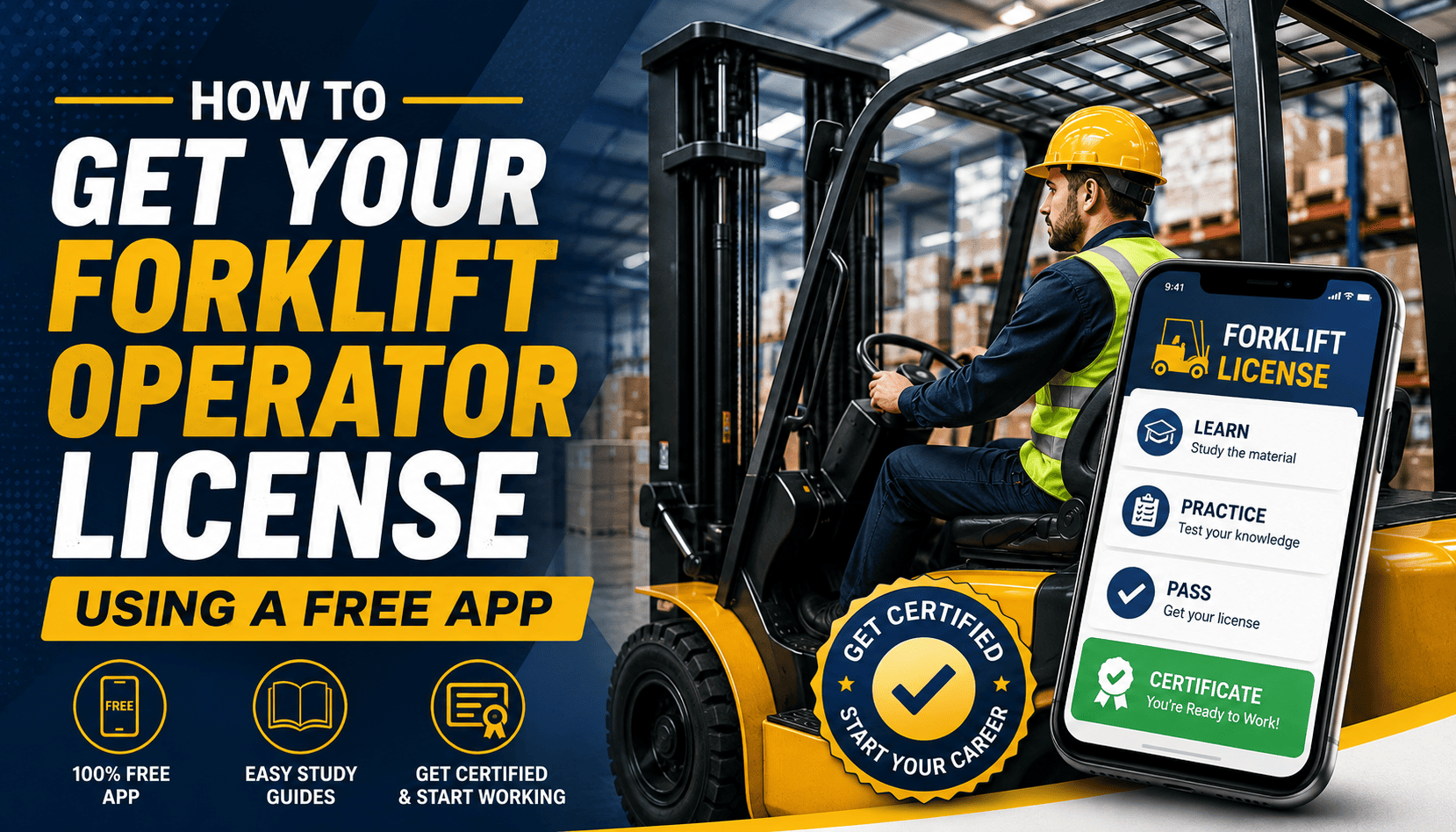
That equation has changed. Today, a forklift certification app lets you work through the entire theory component from your phone — between shifts, on a lunch break, or late at night when it is finally quiet. No commute, no classroom, no rigid timetable.
This guide breaks down exactly what the law requires, walks through four platforms where you can start right now, and explains the fastest way to get from zero to certified. If growing your skill set toward areas like CDL training or welding certification is on your radar, we will cover how forklift training connects to those paths as well.
What the law actually requires
The federal standard that applies here is OSHA 29 CFR 1910.178(l). It applies to anyone who operates a powered industrial truck — forklifts, reach trucks, pallet jacks, order pickers — in a workplace setting. Operating one of these machines without documented certification is a compliance violation for your employer and a safety risk for everyone around you.
OSHA divides the certification process into three components. The first is formal instruction, which covers theory — rules, procedures, hazards, and safe operating principles. The second is practical training, meaning real time on real equipment. The third is a performance evaluation conducted by a qualified person who confirms you can operate safely in your actual work environment.
A forklift certification app handles the first component completely. The other two still happen in person, which is something to understand going in.
Recertification is required every three years, or earlier if you are reassigned to a different type of equipment, observed operating unsafely, or involved in a workplace incident. Keeping your certification current is a legal obligation, not a suggestion.
What happens inside a forklift certification app
When you log into a forklift certification app for the first time, you will find the course divided into short modules — a mix of instructional content, diagrams, and knowledge checks that make sure the material is landing before you move on.
Your progress saves automatically after each section. Close the app and come back two days later — you pick up exactly where you stopped. Once you complete the full curriculum and pass the final assessment, the platform generates a digital certificate confirming you have finished the formal instruction portion of your OSHA-required training.
Most people complete the entire process in two to four hours. The certificate is downloadable and can be emailed directly to your employer or HR department, making compliance documentation quick and clean.
What the training covers
A well-built forklift certification program covers every knowledge area OSHA expects an operator to understand before stepping onto the floor:
- Equipment types — the differences between sit-down counterbalanced forklifts, reach trucks, order pickers, and pallet jacks, and why operating one does not automatically qualify you for another
- Pre-shift inspections — what to check before every use, how to log defects properly, and the threshold for pulling equipment out of service
- Load physics and stability — how weight distribution affects tipping risk, how the stability triangle works in practice, and the mistakes that cause accidents
- Operating procedures — safe speed zones, how to take turns with a loaded fork, navigating inclines, and pedestrian traffic protocols
- Incident response — what to do if a forklift tips, how to handle a spill, and the correct way to document and report a workplace accident
Working through this material before your hands-on evaluation puts you in a much stronger position when the practical portion begins.
Four platforms you can use starting today
Alison — Full course, free, certificate included
Alison is one of the most widely used free learning platforms globally. Their forklift operator course walks through safe operation fundamentals, pre-shift inspection requirements, load handling, and OSHA compliance standards.
The entire course is free. You study through video content and module quizzes, and when you finish, you receive a digital certificate you can share directly with your employer. A printed version is available for a small fee if your employer prefers physical documentation.
Beyond forklift training, Alison hosts courses on welding fundamentals, workplace safety standards, and CDL preparation — making it one of the most efficient places to build a stack of credentials from one account.
WorkHub — Safety-focused lift truck training at no cost
WorkHub offers free online safety training designed for operators and the employers responsible for keeping them compliant. Their lift truck course covers hazard identification, safe operating procedures, and pre-use inspection checklists.
Completion tracking is built in, which simplifies record-keeping for employers managing multiple certified operators. If your company already relies on WorkHub for WHMIS, fall protection, or confined space training, adding forklift certification to the same system requires no extra setup.
ForkliftCertification.us — Study materials and practice exams
The Forklift Certification Institute provides a free learning center stocked with structured study content: an introduction section, OSHA guideline breakdowns, operational procedures, safety protocols, flashcards, and both a 10-question and 20-question practice exam.
You can retake the practice tests as many times as you want — the passing threshold is 80%, and the repetition is genuinely useful for building retention. The free materials are designed to prepare you for the formal exam, which is part of their paid program if your employer requires official documentation.
ForkliftPro — Mobile inspection tool for certified operators
ForkliftPro is an Android app built for operators who are already certified and need a reliable way to manage ongoing compliance. It is not a training course — it is an inspection and documentation tool used on the job.
The app gives you customizable pre-shift inspection templates, the ability to photograph and log defects, and automatic PDF report generation. All data syncs across devices and is stored in the cloud, which means inspection records are available instantly during an OSHA audit.
For employers running a fleet of forklifts, ForkliftPro replaces paper checklists and makes compliance documentation something that practically runs itself.
Can you get fully certified without leaving home?
Partially, but not completely. The app covers OSHA’s formal instruction requirement — and it covers it well. What it cannot replace is the hands-on practical training and the live performance evaluation that OSHA also mandates.
Your employer, or a designated trainer at your worksite, still needs to observe you operating actual equipment in your actual work environment. OSHA is explicit: the evaluation has to reflect the real conditions of the facility where you will be working, not a generic course scenario.
Completing the app first is the right sequence. It means you show up to the practical evaluation with a solid theoretical foundation — you already know what a stability triangle is, why load center matters, and how to read a capacity data plate.
Why companies prefer app-based training
For any business that onboards operators regularly, the economics of app-based OSHA forklift training are difficult to argue with. Organizing a group classroom session means scheduling, coordination, lost floor time, and an outside instructor’s day rate. That adds up fast.
Mobile training lets each worker complete the theory portion independently, on their own schedule, without pulling the rest of the team off the floor. Platform costs range from free to around $60 per user — a fraction of traditional options. And because certificates and completion records are digital, pulling documentation during an OSHA inspection takes seconds instead of minutes.
Where forklift certification can take you
Forklift certification is a practical credential that opens immediate doors in warehousing, manufacturing, and logistics. But it also sits naturally alongside other skills that employers in those same industries actively need.
Welding certification is one of the most complementary paths. Facilities that rely on forklifts for material handling often employ welders for maintenance and fabrication work in the same building. Free welding courses on platforms like Alison provide a strong foundation, and from there, pursuing formal welding certification online through accredited programs is a realistic next step.
CDL training is another high-value direction. Comfort with heavy equipment translates well to commercial driving, and a CDL opens access to trucking and logistics roles that consistently pay above warehouse averages.
Forklift certification is a starting point worth taking seriously — and the skills you build alongside it multiply its value.
Start this week
The theory portion is the only part of your forklift certification that you can complete entirely on your own time. Choose a platform, work through the modules, and talk to your employer about scheduling the hands-on evaluation once you have your certificate in hand.
Study the theory on your phone. Pass the assessment. Show your employer you can handle the equipment. That is the complete path — and the first step costs nothing.